Bring Governance Work into One Place with Accurity Tasks
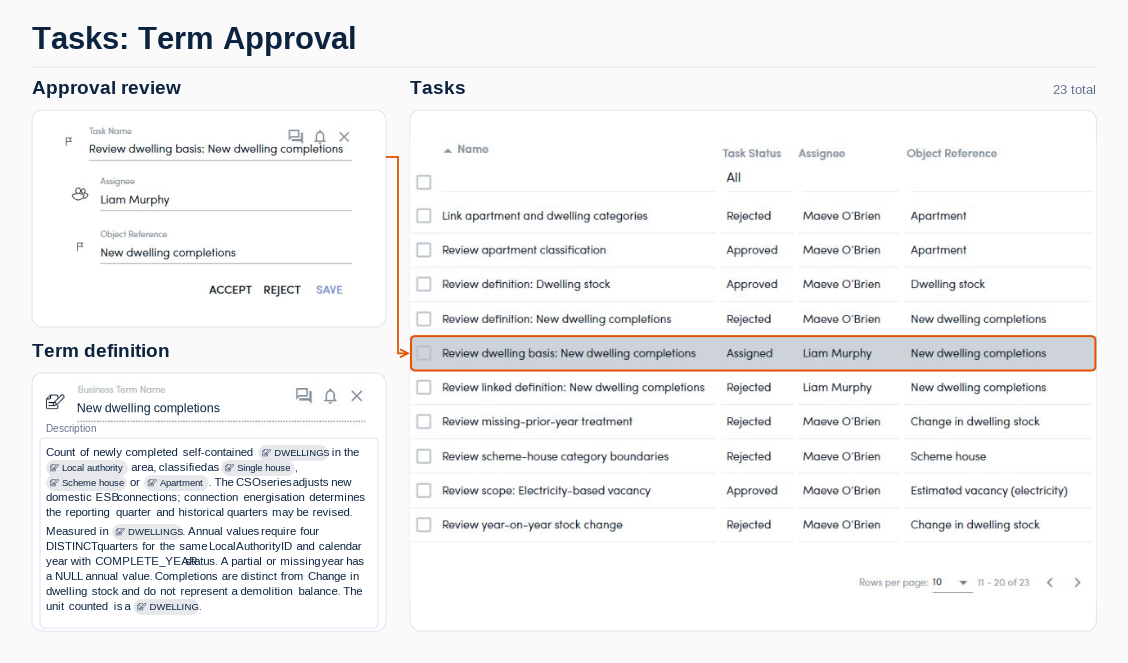
That changes with Accurity Tasks. Tasks brings governance work into Accurity itself: a unified inbox where every request, approval, and issue is tracked, assigned, owned, and resolved. The conversations and the outcomes finally live in the same place.
Built on a Foundation That Already Works
Tasks is not new ground for Accurity. Issue tracking has been part of the Accurity Data Quality solution for years, used by data quality teams to log, assign, and resolve data issues. That same foundation now powers a wider set of governance work. Customers running Data Quality already know the model: a task has a type, an owner, a status, a history, and a clear resolution. We are simply expanding what counts as a task.
Expanded Task Types
Alongside the existing Issue task type in the Accurity Data Quality solution, two task types expand Accurity:
Term Approval. Propose, review, and publish business glossary terms through a structured workflow. Data stewards initiate term proposals, and domain owners review, request changes, approve, or reject them.
Data Access Approval. Request and grant access to data assets through a governed approval flow. (Covered in detail in our companion post.)
Both new task types use the same Tasks engine, the same inbox, the same notifications, and the same audit trail. Customers learn the pattern once and apply it across glossary, catalog, and quality.
Use Accurity Tasks, or Use Your Own
Many organizations already run a corporate-wide work platform like Jira or ServiceNow, with policies that say all work belongs there. Accurity Tasks respects that. Tasks can integrate with external work platforms so governance work appears where your teams already work, without duplication.
Teams that prefer the Accurity Tasks inbox use it natively. Teams that live in Jira or ServiceNow get Accurity tasks mirrored into their tool of choice, with status and updates flowing both ways. The governance object stays in Accurity. The work tracking happens wherever your teams are most comfortable.
Term Approval: How It Works
A business glossary is only as trustworthy as the process that produces it. Free-for-all editing leads to inconsistent definitions, contested ownership, and terms nobody fully trusts. Term Approval gives every new glossary term a clear lifecycle.
Propose. A data steward drafts a new term, with definition, examples, and any links to related catalog objects.
Review and approve. The proposal becomes a Term Approval task assigned to the domain owner. They can approve, request changes, or reject, with comments captured in the task history.
Publish. Approved terms become visible to all glossary users, with a clear record of who proposed and who approved.
Edit and re-review. Any edit to an approved term opens a new Term Approval task and moves the term back to a draft state, until the change is approved. Approved versions are never silently overwritten.
Term Approval is domain-aware by design. It plugs directly into Domain Management. Each domain runs its own approval cycle with its own steward and domain owner, so the people closest to the meaning of the data are the ones deciding what it means.
See It in Action
A Finance domain steward proposes a new term: “Gross Revenue”. The Finance domain owner sees the Term Approval task in the inbox, reviews the definition, requests one small wording change, and approves it. The term is published with full attribution.
A Marketing analyst notices that “Gross Revenue” is being interpreted differently in a campaign performance report. Instead of changing the approved term directly, they add a comment to the term and ask Finance to clarify the definition. The discussion stays attached to the term, where the right people can review it in context.
A compliance officer audits how “Gross Revenue” was defined and approved. They open the term itself and see the complete history: the proposal, approval, comments, changes, approvers, and timestamps connected to the term. No need to ask anyone, dig through email, or hunt for tasks.
Key Benefits
Bring governance work into Accurity, instead of scattering it across email, Slack, and ticketing tools
Match how real organizations already work, with data stewards proposing and domain owners approving
Make audits straightforward, with a complete history kept on the object itself, accumulated across every task and comment that touched it
Learn the model once, then apply it across issues, term approvals, and access requests today, with more task types to come
Fit the way your company already works, with optional integration into corporate work platforms like Jira and ServiceNow
Why It Matters
Governance platforms that store decisions but ignore the work behind them put the burden on people. Stewards chase approvers in email. Owners forget which term they signed off on last quarter. Auditors ask for evidence that nobody can find. The metadata is in the catalog, but the trust is not.
Tasks closes that gap. Every governance decision now comes with the conversation that produced it, attached to the object it concerns, owned by a real person with a clear status. The platform stops being a passive repository and becomes an active workspace where governance actually gets done.
What Comes Next
The Tasks model is built to expand. Accurity covers three task types today: issue tracking (already in the Accurity Data Quality solution), term approval, and data access approval. The roadmap continues with three directions, all aligned with where the metadata management market is moving:
Active metadata refresh tasks. Continuous, scheduled refresh of catalog and lineage so metadata never goes stale, in line with how analysts define active metadata management.
Data quality monitoring tasks. Scheduled and event-triggered profiling and data quality checks raised as tasks for the right owner the moment a threshold is breached.
Policy-driven tasks. Tasks raised automatically when a classification, an access pattern, or a quality condition triggers a defined policy, turning governance signals into action.
Each new task type will use the same inbox, the same ownership model, and the same audit trail. One way to manage governance work, growing in capability over time.
👉 Learn how Accurity Tasks brings the work behind governance into one place, starting with Term Approval. And read our companion post on Data Access Approval to see the second new task type in action.
Want to see Accurity for yourself?
Get a free personalized 1-on-1 demo.


