One Governance Platform. Multiple Business Contexts.

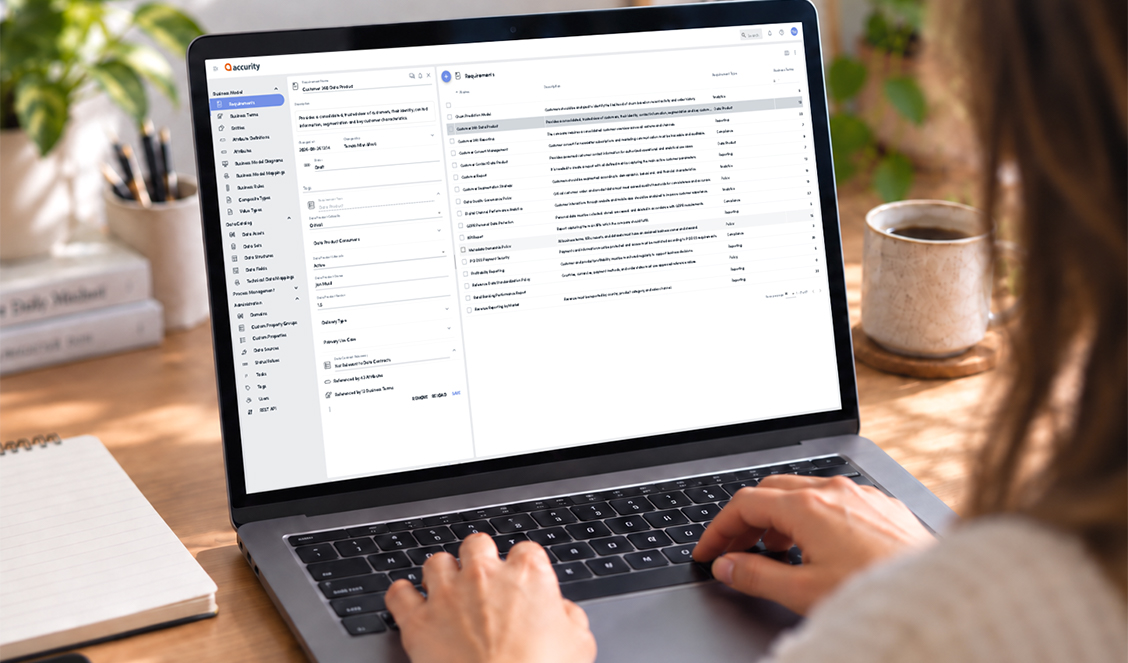
Before long, the same object contains dozens of custom fields. Many of them only apply in specific situations.
Most governance platforms respond by adding more metadata to the same object. Every new governance initiative introduces another group of fields. Over time, users are faced with long, cluttered forms where only a fraction of the information is relevant. Administrators gain flexibility, but users lose clarity.
That changes with Accurity Dynamic Custom Properties. Powered by our new Master Custom Property capability, Dynamic Custom Properties allow organizations to build metadata models that adapt to the business context.
Instead of exposing every custom field to every user, Accurity displays only the metadata that belongs to the selected type of object or governance scenario. The platform remains flexible, while the user experience stays focused and intuitive.
Governance That Adapts to Your Organization
Modern data governance is no longer limited to business glossaries and technical catalogs. Organizations are expected to govern data products, AI assets, regulatory documentation, privacy classifications, business capabilities, and countless industry-specific concepts.
Each initiative introduces its own metadata requirements. Yet they all need to coexist within a single governance platform.
Traditional approaches usually solve this problem in one of two ways. They either continue adding custom fields until every object becomes increasingly difficult to use, or they introduce new object types for every scenario. Both approaches make the governance model harder to maintain over time.
Dynamic Custom Properties offer a different approach. Administrators define a Master Custom Property that represents the business context of an object. It might describe a Data Asset Type, Data Product Type, Processing Type, Dataset Category, or any other classification that makes sense for the organization.
Each possible value is connected to its own Custom Property Group. This group contains only the metadata relevant to that particular context. Instead of creating separate governance models, organizations maintain one consistent platform that automatically adapts to different business needs.
One Object. Multiple Metadata Experiences.
Consider a public sector organization managing both internal operational datasets and datasets published through a national open data portal. Both are Data Sets and belong in the same governance platform, but they require very different metadata.
Internal operational datasets need information such as business owner, refresh frequency, source systems, and service-level agreements. Published datasets must additionally capture DCAT-AP metadata such as publisher, license, spatial coverage, temporal coverage, and available distribution formats.
Without Dynamic Custom Properties, every dataset would display every field. Internal users would spend time navigating publishing metadata they never use. Publishers, meanwhile, would have to work around operational fields that have no relevance to open data.
With Dynamic Custom Properties, the experience changes. Selecting Published Dataset automatically displays the DCAT-AP metadata group. Selecting Internal Dataset reveals only the metadata required for internal governance.
Both continue to use the same underlying Data Set object. But each presents a metadata experience designed specifically for its purpose.
The same principle applies across many other scenarios. Organizations can use it for AI governance, data products, regulatory frameworks, and industry-specific standards.
Built for Evolving Governance
Governance requirements rarely stay the same for long. New regulations appear, business priorities change, and organizations introduce AI initiatives, launch data products, or adopt new metadata standards. Every change places additional demands on the governance model.
Dynamic Custom Properties make those changes easier to manage. Instead of redesigning object types or introducing another collection of optional fields, administrators can extend the existing metadata model. They simply define new business contexts and the metadata that belongs to them.
The platform grows with the organization while remaining familiar to the people who use it every day. Users continue working with clean, focused object details, even as governance becomes more sophisticated behind the scenes. See It in Action
Dynamic Custom Properties can support different governance scenarios without requiring separate object types or duplicated metadata models.
A bank can capture different metadata for operational systems and regulatory reporting assets while keeping both as Data Assets. A data product team can distinguish between analytical products, operational products, and AI training datasets. Each can have its own lifecycle metadata and ownership requirements.
A government organization can maintain both internal datasets and DCAT-AP compliant published datasets within the same catalog. Users only see and complete the metadata appropriate for each scenario.
Different governance models. One consistent platform.
Key Benefits
Dynamic Custom Properties improve governance for both administrators and business users. Governance teams gain the flexibility to support multiple business contexts without redesigning the platform. At the same time, users benefit from a cleaner and more intuitive experience that keeps their attention on the information that matters.
Key benefits include:
Adapt metadata automatically to different business contexts.
Display only the information relevant to the selected object type or scenario.
Support multiple governance models within a single platform.
Reduce clutter and improve metadata quality.
Extend governance without introducing additional object types.
Keep the platform intuitive as governance requirements continue to grow.
Why It Matters
Data governance is becoming broader every year. Organizations are expected to manage traditional business metadata alongside AI documentation, data products, regulatory frameworks, privacy obligations, and industry-specific standards.
These initiatives may have different objectives, but they share one requirement. They need a governance platform that can evolve without becoming increasingly complex for the people who use it.
Dynamic Custom Properties provide that flexibility. Rather than forcing every user to work with the same static metadata model, Accurity adapts the experience to the selected business context. Underneath, organizations still maintain one consistent governance platform.
Administrators gain the freedom to evolve governance as new requirements emerge. Users continue working with metadata that is relevant, understandable, and easy to maintain.
The result is more than cleaner object details. It is a governance platform that grows with your organization instead of becoming more difficult to use every time a new initiative begins.
What Comes Next
Dynamic Custom Properties establish the foundation for even more adaptive governance experiences across Accurity. Future enhancements will continue expanding this model by integrating dynamic metadata with governance workflows, policies, classifications, AI-assisted recommendations, and industry-specific governance templates.
As governance requirements evolve, organizations will be able to extend their metadata model without changing the underlying architecture or compromising the user experience.
One governance platform. Multiple business contexts. One intuitive experience for every user.
Want to see Accurity for yourself?
Get a free personalized 1-on-1 demo.


